
British Business Debt Report
Recently, the British economy has faced significant challenges. Growth has been jammed, and forecasts show that Britain will experience growth slowly among G7 countries in 2025, with a projection of an increase in GDP only 1%.
This slow performance is caused by many factors, such as after the effects of consecutive interest rates and the unsecured global economic uncertainty-before the rapid introduction of a series of new tariffs by the US President who has all moved the pot.
Such a landscape presents considerable obstacles to businesses and employees throughout the country, and many businesses collect more debts than they might have been estimated.
With the current economic conditions in the mind, Swoop is trying to understand the current state of business debt in the UK by analyzing internal data from 52,143 businesses.
Aiming to explain the average debt per company, business age, leadership gender, industrial sector, and regional variation, we will check where in the UK has the largest level of business debt, and provide main insights on how to manage business debt that develops while carving through this waters.
British company debt: deeper appearance
To get a complete picture of the British business debt state, our analysis discusses broad industries such as the technology and food sector, as well as more traditional areas such as mining and aerospace.
It revealed that The average debt per company reached £ 365,375 – A truly true figure underlines the heavy financial pressure experienced by many businesses today.
Special geographical analysis shows that the London business, not surprisingly, has the highest amount of debt in the UK (£ 4.94 billion), followed by Manchester (£ 370 million) and Birmingham (£ 346 million), with Leeds (£ 276 million) and Bristol (£ 249 million) outside the top five.
Which British industry brings the most debt?
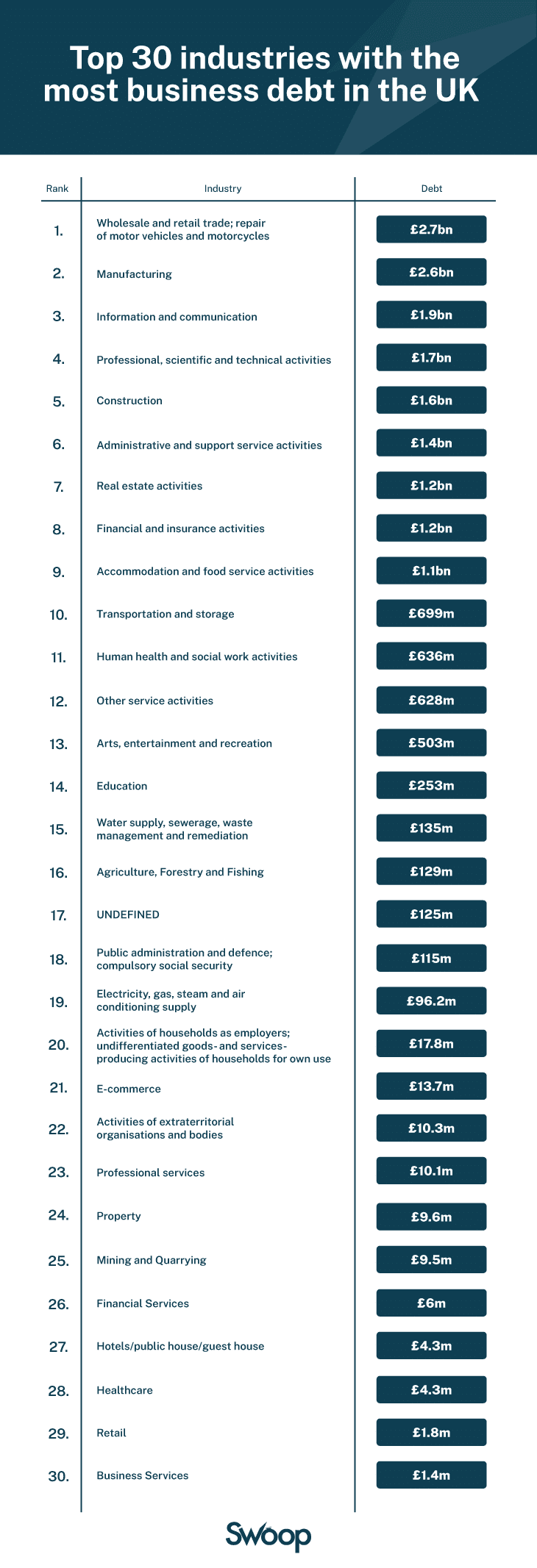
As you expected, certain British industries bear more debt than others. Wholesale and retail trading is far in front of a package with a combined debt of more than £ 2.7 billionWhile manufacturing trade is at £ 2.6 billion behind, reflecting the nature of the capital -intensive industry.
There is also an interesting pattern to be ridiculed between the size of the debt and the age of the company. Does the established company take more debt than a new business, or does startup struggle to get cash?
Well, our research reveals complex conditions. For example, business in the first five years they have collected more than £ 2.5 billion in debt, but so far the largest debt is held by companies aged 21-25 years, with more than £ 1.5 billion.
The lowest debt? Business aged 46 to 50 years.
Once again, there are also broad regional differences among this. Not surprisingly, London’s startups sitting at the top, seeing young companies carrying £ 761 million in debt, while tubridge wells are the location with the largest-old-old business debt calculation-around £ 45 million.
This comparison further highlights that, while established businesses can bring significant debt levels, newer companies have the potential to collect greater levels of debt at a faster level.
Is gender a factor in business debt?
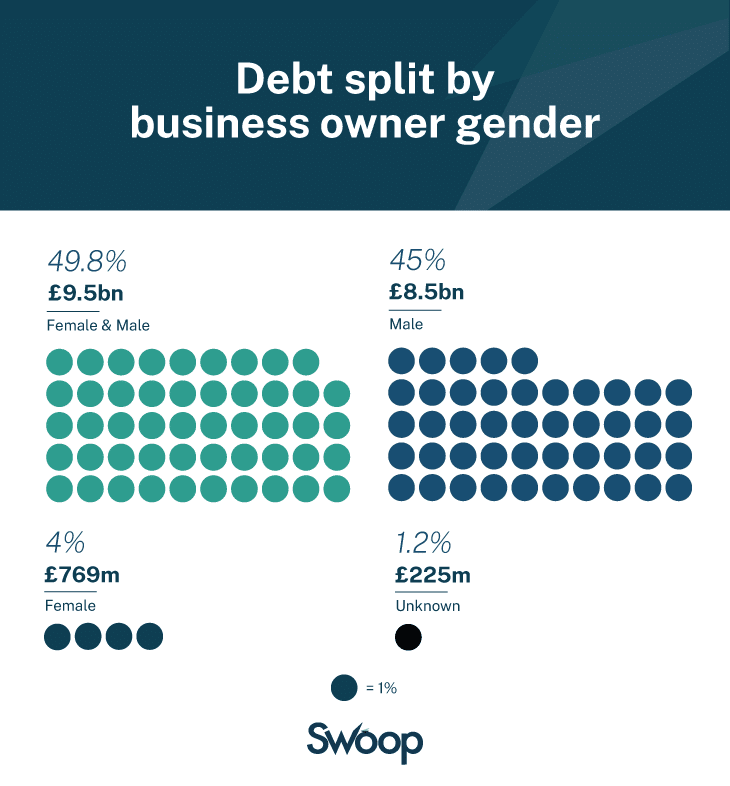
Checking this business leadership, we found that 45% of the donkey is owned by men, compared to only 4% owned by womenWhile 49.8% have male and female leaders together.
But while the average business debt led by women stands at £ 91,755, and numbers for those run by men standing at £ 315,246, a joint business that carries the most debt with an average of £ 698,502-more than double the business managed by men!
Tips for better business debt
Understanding the nuances of business debt is very important in the current economic climate, and our study illuminates financial landscapes where the British business operates. That is why it is important for businesses to recognize that guidance and support are available to help manage and overcome challenging financial situations:
- Assess your financial position: Review your financial statements regularly to understand the level of your debt and overall financial health.
- Prioritize high flowering debt cleaning: Focus on paying off debts with the highest interest rates first to reduce the overall financial burden.
- Explore refinancing options: Consider the existing loan refinancing to get a better interest rate or more profitable requirements. Our guide on how to re -finance business loans offers detailed insights.
- Looking for professional advice: Involved with funding specialists to explore solutions that are tailored to your business. Our guide for small business loans provides valuable information.
- Develop a payment plan: Make a structured plan to manage payments, ensuring they are in line with your business cash flow and operational needs.
Navigating business debt can be frightening, but with the right strategy and proper support, it is possible to manage and even use debt to encourage growth. At Swoop, we are committed to empowering businesses to make better and more informed financial decisions. Subscribe to bulletins and join 95,000+ businesses that still know.
Our methodology
Debt average by the city and business
We analyze the number of businesses in each city and total debt in the city to determine the average business debt. This approach ensures a fair comparison, preventing cities with more businesses than seems to have a higher level of debt that is not proportional.
Industrial debt
This data reflects total debt in various industries for all businesses using Swoop funding.
Industrial debt by city
We compile this data into a table to allow easy filtering. By sorting from high to low, you can identify the top industry with the highest debt in certain cities. For example, “These are the top five industries in debt in London.”
We also have data about industry and how many debt companies have been established between years.
Debt based on sex
This data examines total debt based on gender, given the number of men and women’s businesses among Swoop funding clients. Because we have more businesses led by men in dataset, we calculate the average adjusted average to ensure a fair and balanced comparison.
City data
This dataset includes:
- Average business debt per city
- The level of debt is adjusted to the number of businesses
- Debt trend from time to time
- Business age


